Tuesday, October 30, 2012
Digital Comics
After finding some publishers other than the big name ones like Marvel and DC, I started to think about other types of comics like graphic novels and for this post, online and digital comics. While looking around, I found this awesome website with tons of digital comics called Comixology.com. On this site, you can buy the comics, print them from your computer, and/or download them onto different devices - which i thought was pretty awesome. This website is sort of like Comcast's "On Demand" for comics, meaning you can get them they same day that they are printed and put on shelves or you can even pre-order them. They have every comic you can think of, ones from the big publishers like DC and Marvel, and even free ones (I guess this website is kind of like iTunes, too). Not only does this website hold popular comics, they also hold new ones that may not be very well known as well as graphic novels. This website is definitely something I would recommend to people who often read comics, but if you're like me with buying books from stores so that you have them physically in your hands, then you may not like digital comics too much, unless you are able to print them out.

Saturday, October 20, 2012
Comic Books & Publishing
Now that I have explored a whole bunch of different, yet widely known comics, I have been wondering where new and amateur comic creators publish their work. So in other words, where can people publish comics if their art and writing isn't quite up to par for Marvel or DC yet?
Here are a few places that I found:
If you are looking for a "cool creator-owned" comic book and graphic novel publisher, then you should check out Alternative Comics. Just by looking at the homepage of their website, one can tell that these are not the types of comics that you would find in Marvel, which is why this might be the perfect place for you or your friends to publish!
And, if you are looking to submit only your artwork to a comic publisher, especially if you are an amateur comic artist, you should look into Image Comics, who have a submission page with tons of details on how to submit your artwork. Just by looking at this particular website, you should be able to tell whether your works would fit here or not.
If you're interested in finding the perfect place for a comic, I recommend looking at Comic Vine because they have an extremely large list of possible comic publishers.
Along with this, I also found a page on Publishing Your Own Comic, which could be helpful for those of you interested in self-publishing, which is a pretty big thing now.
Here are a few places that I found:
If you are looking for a "cool creator-owned" comic book and graphic novel publisher, then you should check out Alternative Comics. Just by looking at the homepage of their website, one can tell that these are not the types of comics that you would find in Marvel, which is why this might be the perfect place for you or your friends to publish!
And, if you are looking to submit only your artwork to a comic publisher, especially if you are an amateur comic artist, you should look into Image Comics, who have a submission page with tons of details on how to submit your artwork. Just by looking at this particular website, you should be able to tell whether your works would fit here or not.
If you're interested in finding the perfect place for a comic, I recommend looking at Comic Vine because they have an extremely large list of possible comic publishers.
Along with this, I also found a page on Publishing Your Own Comic, which could be helpful for those of you interested in self-publishing, which is a pretty big thing now.
Thursday, October 4, 2012
Why Just Have "Okay" Comic Book Art When You Can Have GREAT Comic Book Art?
With more opportunity that came during the 1970's, comic book companies like Marvel and DC strived to make their artwork even better since comic book artwork was not as critically acclaimed as it could have been. Companies were no longer looking at the morals and the way that they affected the youth, but instead they were looking at ways to enhance the comic books themselves. During this time, artists began to play with the idea of more color - changing up the art and adding more detail and a variety of colors to the comics. Although the new art was critically acclaimed, all of the comic book companies began to see a decrease in sales. Comics were still being sold on newsstands, but it was at this time that book store chains were evolving, so it made it harder to get the comics sold the way the companies wanted. As an attempt to revive the comic book industry, the companies came together and formed the Academy of Comic-Books Art (ACBA), and eventually the Comic Guild in hopes to do "for comic books what Academy Awards do for movies," as said by the creator of Spider-Man, Stan Lee.
These organizations helped comics become more widely accepted by Americans, and though the sales still saw a decline, the popularity of television gave comics the opportunity to branch out. Marvel and DC both gave out licensing for their characters in order to create the popular Saturday morning cartoons that everyone remembers so much. DC gained profits from Batman, Wonder Woman, and Superfriends series while Marvel licensed The Incredible Hulk and The Fantastic Four - Marvel even got the rights to print Star Wars comic books which helped their profit extremely. All of these cartoon series were most likely the reason for the movies considering television helped spread the word, keeping Marvel and DC as the leaders in the comic book world.


"Archetypes, Commercialism, and Hollywood." A History of the Comic Book. Random History, 18 Mar. 2008. Web. 4 Oct. 2012. <http://www.randomhistory.com/1-50/033comic.html>.
These organizations helped comics become more widely accepted by Americans, and though the sales still saw a decline, the popularity of television gave comics the opportunity to branch out. Marvel and DC both gave out licensing for their characters in order to create the popular Saturday morning cartoons that everyone remembers so much. DC gained profits from Batman, Wonder Woman, and Superfriends series while Marvel licensed The Incredible Hulk and The Fantastic Four - Marvel even got the rights to print Star Wars comic books which helped their profit extremely. All of these cartoon series were most likely the reason for the movies considering television helped spread the word, keeping Marvel and DC as the leaders in the comic book world.


"Archetypes, Commercialism, and Hollywood." A History of the Comic Book. Random History, 18 Mar. 2008. Web. 4 Oct. 2012. <http://www.randomhistory.com/1-50/033comic.html>.
Wednesday, October 3, 2012
"Your Friendly Neighborhood Spider-Man."
So after WWII and the extreme skepticism of how comic books were warping the minds of our youth, Marvel decided that it was time to introduce comic book characters who showed weakness and a common life of some kind; demonstrating that not all people are perfect and that "the superhero could be you." With this concept was the creation of Spider-Man. Written by Stan Lee and drawn by Steve Ditko, a small backstory for people who have no idea what I am talking about (which would be surprising considering the mass amount of number one films and video games) is as follows: Peter Parker was sort of a wimp before he actually became Spider-Man and what keeps him going is not revenge, but the guilt of knowing that he could have saved his Uncle Ben, who was the only father figure that he had, when he was killed. He was attending a science exhibit when he was bitten by a spider and given a bit of radioactivity - meaning he was actually given spider abilities. Unlike all of the other superheros who were around during this time, Spider-Man had no one else to talk to except himself - so none the less, he had to struggle with himself as well throughout each comic.
The original comic debuted in 1962, and it was almost not even published, but it was decided that it would be a one-time type of thing because the editor thought that readers would find the concept of spiders "distasteful." Spider-Man was threw in last minute because of the cancellation of another comic that was being published previously and eventually her helped characterize The Marvel Age. I bet that editor is happy he decided to throw him in now, huh. Later when the sales for that certain comic book came in, the numbers were outstanding and better than any other book that was previously published.
Once Spider-Man was given his own comic, Stan Lee became the editor and Jack Kirby was added to the team in order to give Spider-Man a better chance of survival. As someone who is currently located in Indiana, PA, I am not too far away from Johnstown, PA where the original inker, Steve Ditko, lived! Getting back on topic though, like Batman and many of the other superheros in comic books, Spider-Man ends up using his powers for the good - helping all types of civilians and saving them from arch enemies like Carnage and Venom, which he can detect almost to the exact spot due to his very useful spidey-sense.
Over the years, Spider-Man has been turned in to movies, video games, and even more comic books have been written. He is a world-wide hit, and you can bet your bottom dollar that he will continue to be. Sure, I thought Spider-Man movies would be over after Spider-Man 3, but of course they came out with The Amazing Spider-Man, which was just as big of a hit as the previous films. As the years continued with the comic, several villans and characters were added - who could forget Mary Jane (Peter Parker's extreme love intrest) and Green Goblin? I love that Spider-Man has truly proved to be timeless over the years. Like Batman, my 11 year old nephew is more in love with Spider-Man and everything he is about than any other superhero; in fact, he will be walking around his neighborhood this year in the Amazing Spider-Man costume and be the most adorable kid ever. I think its great that kids in this age can enjoy superheros like they did back in the day - I really think my nephew could teach us all a few things about Spider-Man though because one time I made the mistake of mixing up Batman and Spider-Man's arch enemies, and my goodness was that an issue. Luckily he straightened them out for me and I promised to never mix them up again. Note to self: Don'y try to act like you know what you're talking about when it comes to comic books while talking to 11 year olds.
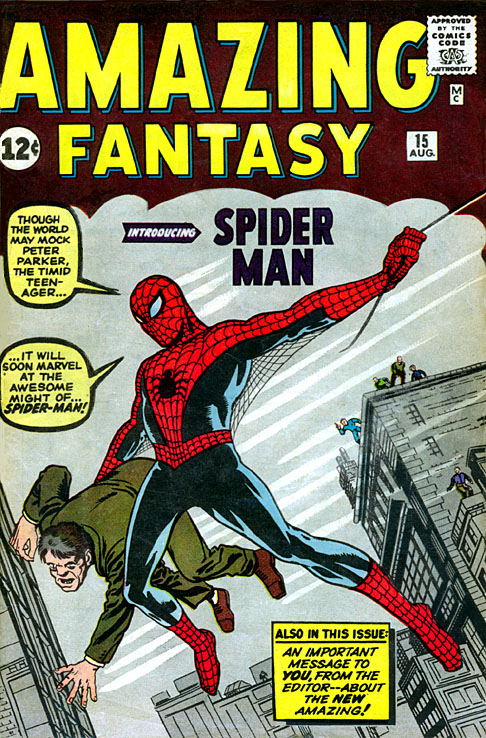
Below is a picture of the first copy from Marvel when Spider-Man was originally introduced to the world. August 15, 1962 Amazing Fantasy #15 (notice the CCA Stamp in the corner that we had a discussion about in my previous blog???)

"Spiderman Biography." History of Spiderman. Super Hero Stuff, 2012. Web. 3 Oct. 2012. <http://www.superherostuff.com/biographies/spideybio.html>.
The original comic debuted in 1962, and it was almost not even published, but it was decided that it would be a one-time type of thing because the editor thought that readers would find the concept of spiders "distasteful." Spider-Man was threw in last minute because of the cancellation of another comic that was being published previously and eventually her helped characterize The Marvel Age. I bet that editor is happy he decided to throw him in now, huh. Later when the sales for that certain comic book came in, the numbers were outstanding and better than any other book that was previously published.
Once Spider-Man was given his own comic, Stan Lee became the editor and Jack Kirby was added to the team in order to give Spider-Man a better chance of survival. As someone who is currently located in Indiana, PA, I am not too far away from Johnstown, PA where the original inker, Steve Ditko, lived! Getting back on topic though, like Batman and many of the other superheros in comic books, Spider-Man ends up using his powers for the good - helping all types of civilians and saving them from arch enemies like Carnage and Venom, which he can detect almost to the exact spot due to his very useful spidey-sense.
Over the years, Spider-Man has been turned in to movies, video games, and even more comic books have been written. He is a world-wide hit, and you can bet your bottom dollar that he will continue to be. Sure, I thought Spider-Man movies would be over after Spider-Man 3, but of course they came out with The Amazing Spider-Man, which was just as big of a hit as the previous films. As the years continued with the comic, several villans and characters were added - who could forget Mary Jane (Peter Parker's extreme love intrest) and Green Goblin? I love that Spider-Man has truly proved to be timeless over the years. Like Batman, my 11 year old nephew is more in love with Spider-Man and everything he is about than any other superhero; in fact, he will be walking around his neighborhood this year in the Amazing Spider-Man costume and be the most adorable kid ever. I think its great that kids in this age can enjoy superheros like they did back in the day - I really think my nephew could teach us all a few things about Spider-Man though because one time I made the mistake of mixing up Batman and Spider-Man's arch enemies, and my goodness was that an issue. Luckily he straightened them out for me and I promised to never mix them up again. Note to self: Don'y try to act like you know what you're talking about when it comes to comic books while talking to 11 year olds.
Below is a picture of the first copy from Marvel when Spider-Man was originally introduced to the world. August 15, 1962 Amazing Fantasy #15 (notice the CCA Stamp in the corner that we had a discussion about in my previous blog???)
"Spiderman Biography." History of Spiderman. Super Hero Stuff, 2012. Web. 3 Oct. 2012. <http://www.superherostuff.com/biographies/spideybio.html>.
Saturday, September 29, 2012
Fighting To Be Published
Although comic books were booming in the late 1930's and 40's, the time period after WWII was the hardest for the industry considering comics had to now compete with not only comics about new topics, but with the television industry. Comics were fighting for attention when television came into view and there was one man who was trying to shut them down for good - Dr. Fredric Wertham; also known as "The Comic Book Vilan." This man was under the impression that comic books corrupted our youth and wished to have them censored - his efforts would show a lasting effect on comic book publishing to this day. In an attempt to slow the backlashes that were coming from critical reviews of the comic books, DC began to publish the names of board members inside the cover of all DC books - these board members were well known people throughout the public and with their names on the books they promised that the comics were "held up to the standards of wholesome entertainment."
Dr. Fredric Wertham went on a seven year research fest in order to investigate the effect that comics had on children. Once he went public with his ideas about comic books, people all over the country began to question them, and soon an article appeared in Time magazine, which featured Detroit Police Commissioner Harry S. Toy who stated that the comics were "Loaded with communist teachings, sex, and racial discrimination." Some people even said that the comic books were training kids to act like animals and that they distorted real life. Things got so intense all over the country that comic books were banned in cities and counties, and some places even held public burnings for the books; needless to say the comic book publishers were very worried that they may never recover from this.
In 1948 the Association of Comic Magazine Publishers (ACMP) was formed in order to set guidelines for comic books which would have to be approved of the ACMP board before they were published. Some big comic book publishers like DC already had their own boards though, so they did not join and some publishers even dropped out because they didn't agree with the approval guidelines.
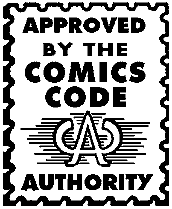
By 1955, everything was settled. Comic book companies came together and created the Comic Magazine Association of America (CMAA), and together they came up with the Comics Code Authority (CCA) which was approved by the Senate and they were told that they were taking "steps in the right direction." The Senate also decided that Dr. Fredric Wertham's research could not be fully backed up since his research was only done on juvenile delinquents and not on all children entirely.
Today the CCA is hardly relevant because their stamps are not as large and noticeable on the covers as they once were, so instead publishing companies often put "Suggested For Mature Readers" since they still publish comics even though they don't meet the CCA requirements - Dr. Fredric Wertham is probably rolling in his grave because of this.

Coville, Jamie. "Seduction of the Innocent and the Attack on Comic Books." Seduction of the Innocent and the Attack on Comic Books. Penn State University, n.d. Web. 29 Sept. 2012. <http://www.psu.edu/dept/inart10_110/inart10/cmbk4cca.html>.
Dr. Fredric Wertham went on a seven year research fest in order to investigate the effect that comics had on children. Once he went public with his ideas about comic books, people all over the country began to question them, and soon an article appeared in Time magazine, which featured Detroit Police Commissioner Harry S. Toy who stated that the comics were "Loaded with communist teachings, sex, and racial discrimination." Some people even said that the comic books were training kids to act like animals and that they distorted real life. Things got so intense all over the country that comic books were banned in cities and counties, and some places even held public burnings for the books; needless to say the comic book publishers were very worried that they may never recover from this.
In 1948 the Association of Comic Magazine Publishers (ACMP) was formed in order to set guidelines for comic books which would have to be approved of the ACMP board before they were published. Some big comic book publishers like DC already had their own boards though, so they did not join and some publishers even dropped out because they didn't agree with the approval guidelines.
By 1955, everything was settled. Comic book companies came together and created the Comic Magazine Association of America (CMAA), and together they came up with the Comics Code Authority (CCA) which was approved by the Senate and they were told that they were taking "steps in the right direction." The Senate also decided that Dr. Fredric Wertham's research could not be fully backed up since his research was only done on juvenile delinquents and not on all children entirely.
Today the CCA is hardly relevant because their stamps are not as large and noticeable on the covers as they once were, so instead publishing companies often put "Suggested For Mature Readers" since they still publish comics even though they don't meet the CCA requirements - Dr. Fredric Wertham is probably rolling in his grave because of this.
Coville, Jamie. "Seduction of the Innocent and the Attack on Comic Books." Seduction of the Innocent and the Attack on Comic Books. Penn State University, n.d. Web. 29 Sept. 2012. <http://www.psu.edu/dept/inart10_110/inart10/cmbk4cca.html>.
Wednesday, September 26, 2012
Da Na Na Na Na Na Na Na BATMAN
For those of you who may have been hiding under a rock for the past 73 years while films galore were being made about one of the most famous comics in the world, here is a small synopsis on the storyline of Batman - a very small synopsis. So basically Bruce Wayne (Batman) witnesses his parents death as a teenager and vows to avenge their death by taking down criminals. Now, unlike Superman, Batman has no super powers. He is an ordinary guy with a ripped body who was left a ton of money in which he could use to get top of the line weapons and vehicles in order to stop the mayhem and crime going on in his hometown of Gotham.
After reading the history of the comic book, I think that it is fair to give the credit of blowing up comics to the two most famous superheros in the world: Superman and Batman. In 1938, DC introduced Superman to the world, and the next year after they realized how big of a hit the idea of superheros were to consumers, they hired Bob Kane to create a superhero "as powerful and appealing as Superman." In order to find inspiration for this superhero who would also help shape the comic book world, Kane looked to Leonardo da Vinci's sketch of a man trying to fly with some type of bat wings, masked heros like Zorro, and movie about a bat faced villan called "The Bat Whisperer."
After realizing that he would not have time to both draw and write the comic, even though he had experience in both areas, he was partnered up with Bill Finger, who ended up writing all of the dialogue and collaborated with Kane. A year after Batman was first published, Kane decided to add a sidekick to the comic so that Batman would have someone to talk to, which is where Robin comes in (or Robin The Boy Wonder in 1940.) Once Robin was added, the comic book hit a new high in rating with consumers and the comic became even more popular, if that is possible, when Kane created arch enemies for Batman in which he would defeat during the comic. Popular arch enemies for Batman include the Joker, the Riddler, Penguin, Two-Face, and Catwoman. What I love most about the idea of Batman is that it has been published and republished over the years, just getting more popular with each movie and graphic novel that comes about, because I guarantee DC will only keep republishing newer versions, and movie remakes will keep being made because of this timeless superhero.
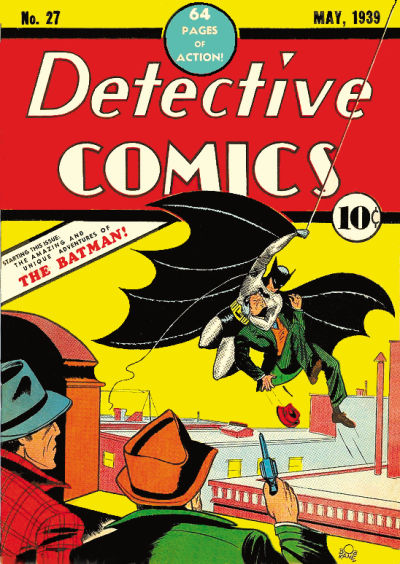
I really should have interviewed my 11 year old nephew for this, because he knows the life of Batman like the back of his hand. Here is a picture of the original copy of Detective Comics' No. 27 from May, 1939. I imagine it is quite pricey these days, and rare as can be.

"Batman's History." Batman's History. Beltmasters Direct, 2006. Web. 26 Sept. 2012. <http://www.beltmastersdirect.com/batmanhistory.htm>.
After reading the history of the comic book, I think that it is fair to give the credit of blowing up comics to the two most famous superheros in the world: Superman and Batman. In 1938, DC introduced Superman to the world, and the next year after they realized how big of a hit the idea of superheros were to consumers, they hired Bob Kane to create a superhero "as powerful and appealing as Superman." In order to find inspiration for this superhero who would also help shape the comic book world, Kane looked to Leonardo da Vinci's sketch of a man trying to fly with some type of bat wings, masked heros like Zorro, and movie about a bat faced villan called "The Bat Whisperer."
After realizing that he would not have time to both draw and write the comic, even though he had experience in both areas, he was partnered up with Bill Finger, who ended up writing all of the dialogue and collaborated with Kane. A year after Batman was first published, Kane decided to add a sidekick to the comic so that Batman would have someone to talk to, which is where Robin comes in (or Robin The Boy Wonder in 1940.) Once Robin was added, the comic book hit a new high in rating with consumers and the comic became even more popular, if that is possible, when Kane created arch enemies for Batman in which he would defeat during the comic. Popular arch enemies for Batman include the Joker, the Riddler, Penguin, Two-Face, and Catwoman. What I love most about the idea of Batman is that it has been published and republished over the years, just getting more popular with each movie and graphic novel that comes about, because I guarantee DC will only keep republishing newer versions, and movie remakes will keep being made because of this timeless superhero.
I really should have interviewed my 11 year old nephew for this, because he knows the life of Batman like the back of his hand. Here is a picture of the original copy of Detective Comics' No. 27 from May, 1939. I imagine it is quite pricey these days, and rare as can be.
"Batman's History." Batman's History. Beltmasters Direct, 2006. Web. 26 Sept. 2012. <http://www.beltmastersdirect.com/batmanhistory.htm>.
Saturday, September 22, 2012
A Little History On Comic Book Publishing
As someone who doesn't know as much as they wish they did about comics, I decided to research the history of comic book publishing in order to try to pin down the reasons why comic books have been so successful over many decades. As a live human being, I obviously know about Superman, Batman, Iron Man, Charlie Brown, Garfield, and all of the other comics that have made history, as well as movies, over the years. In order for all of these movies to be successful, there had to be consumers buying the comic books, and I'm sure the movies formed more consumers who now purchase these comics since they were fans of the films. I was interested in finding the main source of publishers who are to blame for the popularity of this industry, and to my surprise I actually knew one of them. For over 50 years, Marvel and Detective Comics (DC) have been leading in the publishing industry - making comic books into graphic novels and movies in order to get their names even more well known around the world.
As far as the very well known stylistic features of a comic go, they can be traced back to the medieval broadsheet where people would carve narratives strips into wood. Back in the day, these broadsheets were used to illustrate public executions and caricatures of popular public figures - much like "The Yellow Kid" did in New York City. When comic books were first being distributed in mass quantities all over the world, they were printed on the cheapest type of paper. As far as the well known format of comics goes, "In 1933, Harry Wildenberg and Max C. Gaines (future creator of MAD magazine) folded a traditional tabloid-size comic, Funnies on Parade, in half to create the first four-color, saddle-stitched newsprint comic that would become the format of modern comic books," which was later sold and featured on the popular place of purchase for a number of years, the newsstand.

"Archetypes, Commercialism, and Hollywood." A History of the Comic Book. Random History, Mar. 2008. Web. 22 Sept. 2012. <http://www.randomhistory.com/1-50/033comic.html>.
As far as the very well known stylistic features of a comic go, they can be traced back to the medieval broadsheet where people would carve narratives strips into wood. Back in the day, these broadsheets were used to illustrate public executions and caricatures of popular public figures - much like "The Yellow Kid" did in New York City. When comic books were first being distributed in mass quantities all over the world, they were printed on the cheapest type of paper. As far as the well known format of comics goes, "In 1933, Harry Wildenberg and Max C. Gaines (future creator of MAD magazine) folded a traditional tabloid-size comic, Funnies on Parade, in half to create the first four-color, saddle-stitched newsprint comic that would become the format of modern comic books," which was later sold and featured on the popular place of purchase for a number of years, the newsstand.

"Archetypes, Commercialism, and Hollywood." A History of the Comic Book. Random History, Mar. 2008. Web. 22 Sept. 2012. <http://www.randomhistory.com/1-50/033comic.html>.
Subscribe to:
Posts (Atom)